Salahuddin condemns Indian double standards over Hasina’s media briefing
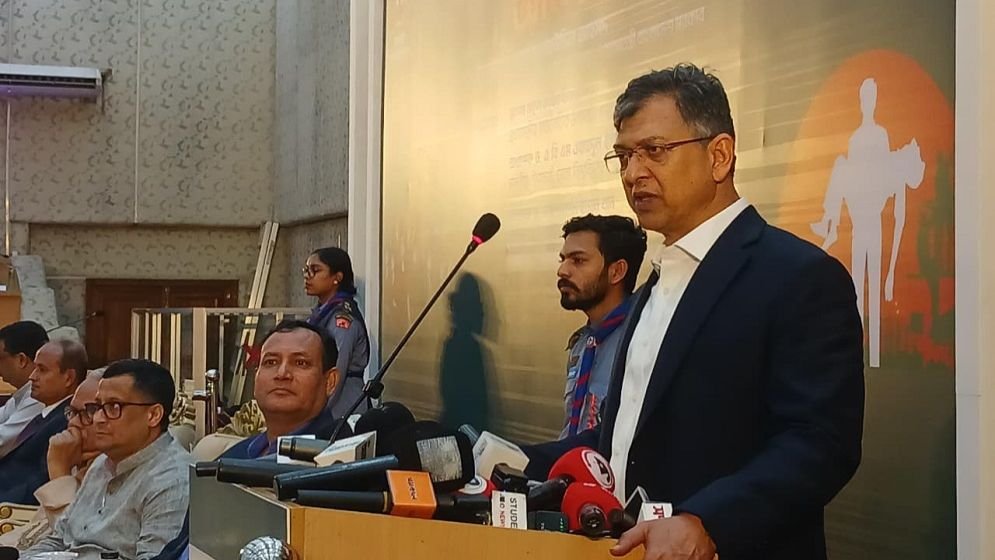
Home Minister Salahuddin Ahmed has condemned India for allowing ousted dictator Sheikh Hasina to repeatedly address the media from its soil – while seeking friendly relations with Bangladesh.
Hopefully, the Indian authorities and government will realise that the opposing positions cannot be sustained, he added.
Speaking at a discussion at the Nawab Ali Chowdhury Senate Building of Dhaka University on Saturday, he said Bangladesh seeks friendly ties with neighbouring India, but those relations must rest on mutual dignity, respect, and sovereign equality.
Furthermore, the BNP government believes the strength of Dhaka-Delhi ties is their mutual interdependence, the home minister said.
Salahuddin warned that diplomatic ties die when a party, like India, adopts such opposite positions: officially denying support for Hasina’s statements against an elected Bangladesh government, while also allowing her to hold anti-state meetings and deliver controversial media remarks from Indian soil.
The Dhaka University Sada Dal and the University Teachers Association of Bangladesh (UTAB) organised the event to mark the second anniversary of the July Mass Uprising.
At the event, Salahuddin questioned the Indian government for allowing Sheikh Hasina to engage in political activities and address the media from Indian soil. Although Indian media reported that New Delhi does not support her statements against the legitimate government of Bangladesh, Ahmed asked why she receives repeated opportunities to hold meetings and speak to global media from Delhi.
Then, the home minister responded to criticisms against the BNP government’s denial of Hasina’s “democratic” media rights, and individual statements.
Certain Indian campaign claim there is no difference between the democratic rights of BNP leaders Salahuddin Ahmed and Tarique Rahman, when they did politics in UK and India, and those of Hasina in India.
Salahuddin said the two cases are starkly different: the BNP leaders were not “fascist,” much unlike Hasina. Salahuddin, and Tarqiue were forced out of Bangladesh for continuing their fight to establish democratic principles inside the country.
But, on the other hand, Hasina and her allies are completely on the opposite trajectory in the country’s democratic struggle, Salahuddin said. The UN has found that the Hasina government killed around 1,400 people, where 13-14% were women and children, in their efforts to cling to power, the home minister noted.
Furthermore, India bears responsibility for Hasina’s anti-Bangladesh remarks and activities from its soil, as the members of the current India government themselves maintained contact with Hasina for ensuring her safe departure from Bangladesh.
Furthermore, an Indian cabinet member personally welcomed Hasina to the country’s airport right after her ouster, whereas Salahuddin was blindfolded, with hands and legs tied together, and dumped inside India in a sack, he said.
“We can never be Awami League,” Salauddin Ahmed said, stressing that Bangladesh will maintain international relations by prioritizing its national interests.
“If a dictator is responsible for genocide and crimes against humanity, how can she be recognised as a leader of democratic culture?” Salauddin Ahmed asked, urging India not to allow its territory to be used for activities that create instability in Bangladesh. He added that Bangladesh would welcome any official statement from the Indian Ministry of External Affairs clarifying that it does not support Hasina’s remarks.
Recalling martyrs such as Wasim and Abu Sayeed, Salauddin Ahmed reaffirmed the government’s commitment to implementing state reforms and constitutional amendments to fulfil the aspirations of the July Mass Uprising.
He described the 5 August victory as the culmination of a 17-year struggle by democracy-loving citizens to restore voting rights and constitutional liberties.
Regarding the Awami League, Salauddin Ahmed stated that the International Crimes Tribunal Act provides clear provisions for legal action against criminal organisations, including property confiscations, suspensions, or bans. He confirmed that ongoing investigations into the party will conclude soon, alongside the individual trials of Sheikh Hasina and her associates.