U.S. Teachers Return to Pen and Paper to Counter AI Use in Classrooms
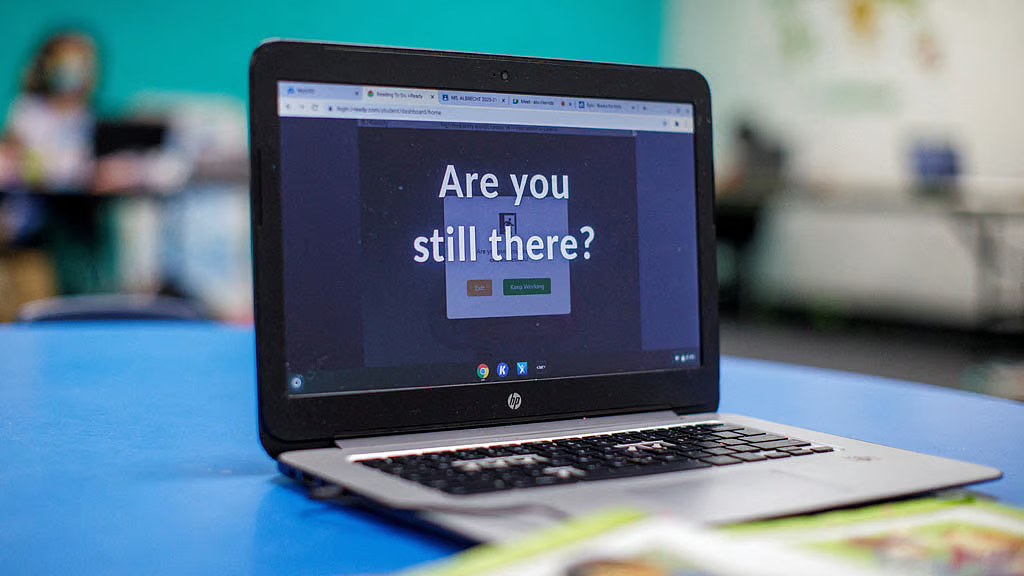
Teachers across the United States are changing classroom instruction and assessment methods to reduce students’ reliance on artificial intelligence chatbots, placing greater emphasis on handwritten assignments, oral examinations and in-class activities.
According to a Reuters report, schools are reducing take-home assignments and shifting more writing, discussion and creative exercises into classrooms to ensure students demonstrate their own understanding and critical-thinking skills.
Tristen Chang, a sixth-grade humanities teacher at a school in San Francisco, has redesigned her classroom activities to discourage students from relying on AI tools. Since last year, she has replaced take-home essays with oral examinations.
During these assessments, students answer 15 questions about characters, settings, themes and metaphors, with each examination taking no more than five minutes.
“Technology has been changing teaching methods for a long time, but the impact of AI is the most significant,” Chang said, adding that many traditional classroom practices have become less effective.
The growing availability of generative AI tools on smartphones and laptops has prompted middle and high school teachers to reconsider how they evaluate students. Reuters spoke with a dozen educators across the country and found that many are assigning less homework, increasing in-class writing and focusing more on students’ thought processes rather than simply their final answers.
Teachers Rethink Traditional Assignments
Rusty Sheb, an English teacher at a junior high school in San Francisco, said students often turn to AI when they feel pressure from parents or teachers to complete assignments at home. To address the problem, he has increased classroom writing time. For one seventh-grade essay assignment, he gives students an entire month to complete the work.
In New York, mathematics teacher Bobson Wang has reduced the number of homework questions and increased classroom practice so he can observe how students solve problems.
“AI has changed not only how students approach mathematics but also how I teach,” Wang said.
The educational impact of AI remains debated. A 2025 Harvard University study found that specialized AI tutors improved students’ learning and engagement. However, a smaller study by the MIT Media Lab found that students who used ChatGPT to write essays completed their work faster but demonstrated lower levels of critical thinking and mental reflection.
Despite the concerns, AI is becoming increasingly common in education. A 2025 RAND survey found that most U.S. students and teachers of English, mathematics and science reported using AI for academic purposes.
Classroom Performance Gains Importance
Some teachers are placing greater weight on in-class performance to determine whether students genuinely understand their lessons.
Megan Hyland, an English teacher at a high school in the New York suburbs, said some students had been going to the bathroom to use AI through their phones, despite a classroom phone ban. She subsequently introduced a rule requiring students to leave their phones behind when using the restroom.
Hyland has also increased the weight of classroom performance in students’ grades while reducing reliance on homework.
“The only way to know whether students are actually thinking critically about a subject is to evaluate their work inside the school,” she said.
Other educators are moving away from predictable questions that AI chatbots can easily answer. Pyan Rockfield, an English teacher at a Bronx high school, said he tries to develop questions that require students to think beyond conventional interpretations.
He also assigns essays based on research papers that require paid access, making it more difficult for students to rely on readily available chatbot responses.
Less Screen Time, More Handwriting
Concerns about AI have also intensified a broader debate over excessive technology use in schools.
Rex Oval, an English teacher at a high school in suburban Chicago, asks students to take writing notebooks from a box at the beginning of class. He avoids using Chromebooks and laptops on approximately 90 percent of school days.
“Since putting laptops away, students have become much more focused on their studies because they no longer have opportunities to cheat,” Oval said.
The use of digital devices, including Chromebooks, expanded significantly during the COVID-19 pandemic. However, concerns about excessive screen time have prompted many U.S. school districts to reassess their reliance on classroom technology.
Hyland also favors handwritten assignments and creative projects that require students to demonstrate their understanding in person. For a lesson on Charles Dickens’ A Tale of Two Cities, she organized a cooking demonstration in which one student used a black-and-white cookie to represent the novel’s famous opening line, “It was the best of times, it was the worst of times.”
She said she tries to choose classroom activities that allow students to demonstrate their creativity in real time.
Some Educators Embrace AI as a Teaching Tool
Not all teachers believe AI should be kept out of classrooms. Some are exploring ways to use it as a teaching assistant, including finding research materials, preparing classroom signs and creating graphics for presentations.
Michael Zaggari, a sociology teacher at a high school in the New York suburbs, uses AI to simplify vocabulary related to historical topics according to students’ learning abilities and to shorten lengthy articles for classroom use.
He also encourages students to use AI when beginning research projects, arguing that learning how to give effective instructions to AI tools can itself develop critical-thinking skills.
“AI is not going to disappear suddenly. Just as we taught responsible use of the internet, we must also teach students the civic responsibility of using AI,” Zaggari said.
As AI becomes more deeply embedded in everyday life, U.S. educators are increasingly divided over how much technology should be allowed in classrooms. While some favor restricting its use, others see it as an essential tool students must learn to use responsibly.