SpaceX’s Starship completes key test flight with successful satellite deployment
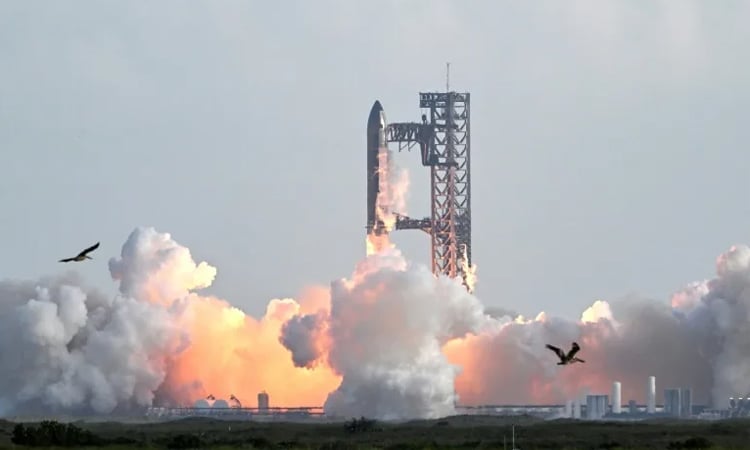
SpaceX’s Starship megarocket lifted off Tuesday on its tenth test flight, marking a significant milestone after a string of fiery failures had raised questions about the program’s future.
The 403-foot (123-meter) rocket, the most powerful ever built, launched from SpaceX’s Starbase facility in southern Texas at 6:30 pm local time (2330 GMT), drawing cheers from the engineering team during a live broadcast.
After liftoff, the Super Heavy booster separated and splashed down in the Gulf of Mexico, producing a sonic boom. Unlike recent flights, SpaceX did not attempt to catch the booster using the tower’s mechanical arms, instead simulating an engine failure to test fallback scenarios.
The mission then focused on the upper stage, also known as Starship, which is designed to carry crew and cargo into space. For the first time, it successfully deployed eight dummy Starlink satellites, with onboard cameras capturing the deployment process live.
However, the flight wasn’t without issues. Some heat shield tiles detached, and part of a flap was damaged during the spacecraft’s descent through Earth’s atmosphere. SpaceX said these outcomes were expected, as the test was designed to stress the vehicle under extreme conditions.
“We’re kind of being mean to this Starship,” said SpaceX communications manager Dan Huot, explaining that the goal was to expose the rocket’s weaknesses.
Elon Musk celebrated the mission’s results on X, writing, “Great work by the SpaceX team!!”
The flight was seen as critical after the previous three ended in upper-stage explosions, including one in June during ground testing. Despite setbacks, SpaceX’s rapid development approach has kept it ahead in commercial spaceflight, with Falcon rockets and Dragon capsules already performing regular missions.
Challenges remain for Starship’s future. A reusable orbital heat shield remains a key hurdle, with Musk noting the difficulty of making it ready for immediate reuse — unlike the Space Shuttle, which required months of refurbishment. Additionally, the vehicle must prove it can refuel in orbit using cryogenic propellants, a necessary capability for deep-space missions.
Time is running short to prepare a version of Starship for NASA’s planned Moon landing in 2027, and for Musk’s own goal of launching an uncrewed mission to Mars by next year.