America-Bangladesh Press Club Marks 18th Anniversary in New York
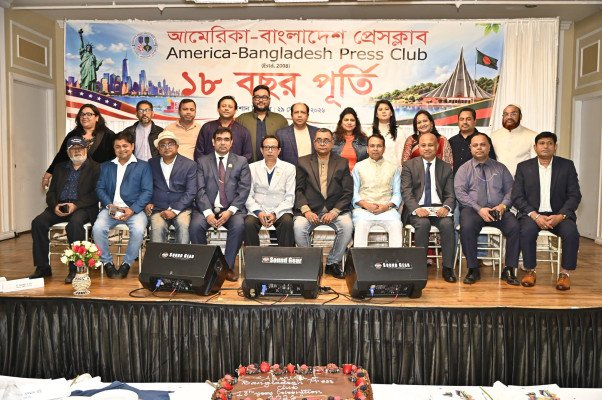
The America-Bangladesh Press Club marked its 18th anniversary with a seminar and cultural program in New York, bringing together journalists, community leaders, business representatives and members of the Bangladeshi-American community.
The anniversary program was held September 29 at Gulshan Terrace in Woodside. The seminar focused on “The Media in Crisis Worldwide,” with speakers discussing the changing media landscape in Bangladesh, the challenges facing Bangladeshi journalists in the United States and the impact of technology and social media on traditional journalism.
Speakers emphasized the importance of responsible, independent and investigative journalism in maintaining public trust. Several participants argued that media outlets that become politically aligned or overly supportive of political interests risk losing credibility with the public.
The seminar was chaired by America-Bangladesh Press Club President Shawkat Osman Rachi and moderated by former president Darpan Kabir.
Among the guests were Gholam Mortuza, press minister at the Bangladesh Embassy in Washington; Mohammad Mozammel Haque, consul general of Bangladesh in New York; and veteran journalist Manzur Ahmed.
Panelists included veteran journalist Saeed Tarek, Moinuddin Naser, Bangladesh Patrika editor Dr. Wazed A. Khan, Jonmobhumi editor Ratan Talukdar, Prothom Alo North America editor Ibrahim Chowdhury, Probash editor and former press club president Mohammad Saeed, and Columbia University lecturer Shoaib Ahmed Bhuiyan.
Press club General Secretary Mashiur Rahman Majumdar delivered the welcome remarks, while Treasurer Mallika Khan Muna, Vice President Mohammad Monzurul Haque and Joint General Secretary Abu Bakar Siddique also addressed the gathering.
During the discussion, veteran journalist Manzur Ahmed said that when media outlets spread misinformation, conceal facts or engage in propaganda, audiences will turn to social media or other sources for information, potentially causing traditional media to lose credibility.
He also stressed that journalists need strong reporting and writing skills and should continue reading and learning, expressing concern that traditional reporting skills are becoming less common.
Gholam Mortuza said media owners and editors bear significant responsibility for the problems facing Bangladesh’s media. He said political favoritism had contributed to a loss of public trust and argued that mainstream media must maintain credibility by reporting facts responsibly.
Mohammad Mozammel Haque said audiences want accurate information and objective journalism. He noted that media organizations must adapt to competition from new platforms, particularly social media, while maintaining responsible reporting. He also stressed that acknowledging and correcting mistakes should be part of a media outlet’s responsibility.
Veteran journalist Saeed Tarek said journalism in Bangladesh has changed significantly from the 1960s and 1970s. He said social media has created new challenges for traditional media and noted that financial difficulties, including problems with journalists’ salaries, can also affect responsible journalism.
Dr. Wazed A. Khan said the media is facing a global crisis as audience behavior changes and social media and artificial intelligence challenge print and electronic media. He said mainstream journalism has an important role in verifying information and countering false claims circulating online.
Journalist Moinuddin Naser emphasized the importance of integrity in journalism, saying honesty should remain a fundamental value for journalists.
Shoaib Ahmed Bhuiyan said journalism cannot maintain credibility when journalists become overly flattering toward those in power. He also discussed the relationship between economic conditions and the media environment.
Mohammad Saeed said Bangla-language media in the diaspora plays a role in building community connections and maintaining links with Bangladesh, but noted that diaspora media is also facing declining readership and other challenges.
Ibrahim Chowdhury said the media crisis cannot be attributed solely to artificial intelligence or technology. He said technology, audiences, news consumption habits and the business model of journalism have all changed, fundamentally altering the definition of media.
Ratan Talukdar said challenges in the media are not new and will continue, but journalists and media organizations must remain vigilant to prevent false information from being published.
The event also featured the unveiling of the anniversary commemorative publication “Alokbartika.” Following the seminar, organizers cut a cake to mark the press club’s 18th anniversary.
The America-Bangladesh Press Club also honored singer M.A. Soeb and actress Moushumi with special recognition crests. Veteran singer Rathindranath Roy presented the award to M.A. Soeb, while Gholam Mortuza and Mohammad Mozammel Haque presented the award to actress Moushumi.
The evening concluded with a cultural program featuring musical performances by M.A. Soeb and Tina Russell. Community members, business leaders and press club members attended the anniversary celebration with their families.