Tarique Rahman Invites Japanese Firms to Invest in Five Priority Sectors
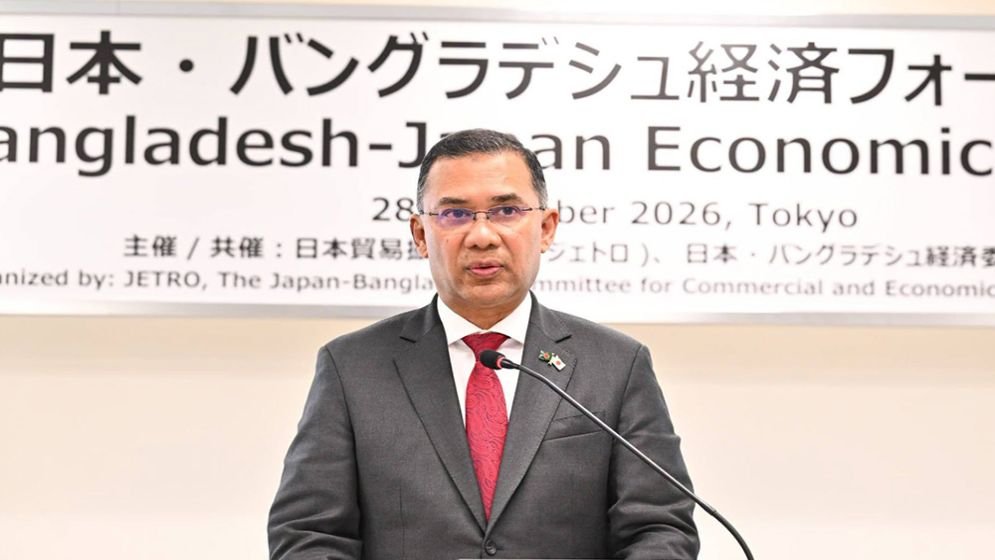
Bangladesh Prime Minister Tarique Rahman has invited Japanese companies to invest in five priority sectors: automotive manufacturing, energy, technology and space cooperation, rail and logistics, and agro-processing and manufacturing.
Speaking at the Bangladesh-Japan Economic Forum Dialogue at JETRO Hall in Tokyo, Tarique called for stronger trade and investment ties between the two countries.
Around 350 Japanese companies currently operate in Bangladesh, but Japanese direct investment remains below $500 million. Bangladesh exported $1.36 billion worth of goods to Japan and imported $2.16 billion in the last fiscal year, according to the prime minister.
Tarique highlighted Bangladesh’s market of more than 180 million people, young workforce and expanding middle class as key advantages for investors. He also noted that the two countries signed an Economic Partnership Agreement this year, granting duty-free access to Japan for 7,379 Bangladeshi products.
In automotive manufacturing, he welcomed Toyota’s plan to establish a vehicle manufacturing facility in Bangladesh, with full production targeted for 2029. He also invited Japanese investment in LNG infrastructure, power generation and renewable energy.
For technology cooperation, Bangladesh plans to establish a Bangladesh-Japan Technology Park focused on artificial intelligence, cloud computing, robotics and electronics manufacturing. The two countries could also expand collaboration in space technology and satellite engineering.
Tarique further outlined plans for a nationwide elevated high-speed rail network connecting major cities, including Dhaka, Chattogram, Sylhet, Rajshahi, Khulna and Barishal. In agro-processing, he encouraged Japanese companies to invest in food processing and the Bangladesh Special Economic Zone in Araihazar, being developed by Sumitomo Corporation.
The prime minister said Bangladesh was working to address investor concerns over energy reliability, infrastructure, customs clearance and taxation, stressing that business certainty and investor confidence were essential to expanding bilateral economic cooperation.