Bangladesh’s Textile Mills Struggle as Cheaper Indian Yarn Floods Market
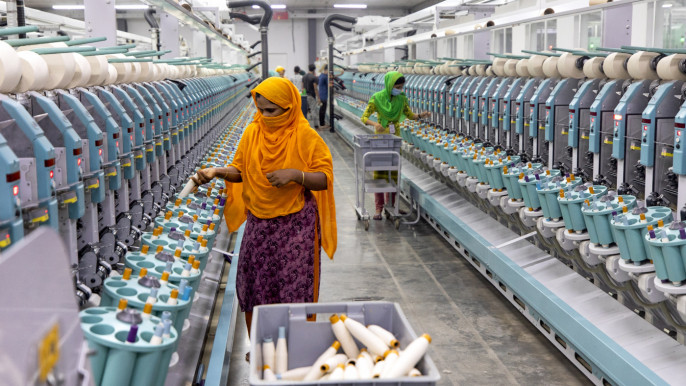
Bangladesh’s textile industry is facing a severe downturn as local mills struggle to compete with a surge of cheaper Indian yarn imports. Warehouses across the country are filled with unsold yarn and fabric, and many factories have been forced to scale down or suspend operations. Industry leaders say the widening price gap between locally produced and imported yarn, driven by India’s export incentives and Bangladesh’s reduced policy support, has placed domestic producers under intense pressure.
According to the Bangladesh Textile Mills Association (BTMA), sales of locally produced yarn have fallen by about 30 percent compared to normal levels. More than 50 textile mills have already partially or fully shut down as producers sell at breakeven or even at a loss to clear excess stock. BTMA President Showkat Aziz Russell said Indian yarn is being sold in Bangladesh at dumping-level prices due to generous export incentives offered by the Indian government. He added that the association has submitted evidence to the commerce ministry, urging policy measures to protect domestic manufacturers.
Over the past three years, India has rolled out multiple incentive programs for textile exporters, including the Remission of Duties and Taxes on Exported Products (RoDTEP) scheme. These measures have given Indian producers a price advantage of roughly $0.25 to $0.30 per kilogram, while Bangladeshi millers face rising production costs and reduced government support. Locally spun 30-count yarn now sells for $2.95 to $3.05 per kilogram, whereas Indian yarn lands at Chattogram port for around $2.68 to $2.72 per kilogram. Fazlee Shamim Ehsan, managing director of Fatullah Fashions Limited, said the difference has transformed sourcing patterns. “Two years ago, I bought nearly all my yarn from local mills,” he said. “Now, 90 percent comes from India.”
The impact has been devastating for local producers. Many factories are running at half capacity or less, and some have halted production altogether. Shahid Alam, deputy managing director of Shah Fatehullah Group, said their warehouses are overflowing with unsold yarn. “We’ve had to store products inside the factory as there’s no space left. Production from 25,000 spindles has already been stopped, and we’re planning to shut down another 25,000 soon,” he said. BTMA vice president Saleudh Zaman Khan noted that mills are now being forced to sell yarn below $3 per kilogram, often at a loss, as the market continues to shrink.
The downturn is also affecting the financial sector. Banks have become cautious about lending to textile businesses as defaults rise. A senior official at a leading commercial bank said they are avoiding term loans and reducing working capital facilities for spinning mills. “Almost every factory we finance is struggling to stay afloat,” he said. “Some are even selling yarn below production cost just to maintain cash flow.”
In addition to price competition from India, local millers accuse illegal imports and misuse of bonded warehouse facilities of worsening the situation. Khorshed Alam, chairman of Little Star Spinning Mills Limited, said weak customs monitoring and the 32 percent wastage allowance have allowed large quantities of untaxed yarn and fabric to enter the domestic market. He estimated that roughly $4.5 billion worth of illegal textile materials are sold annually, undercutting legitimate producers. However, garment exporters argue that the extent of bond misuse is often exaggerated. Fazlee Shamim Ehsan, executive president of the Bangladesh Knitwear Manufacturers and Exporters Association (BKMEA), said the real challenge lies in the unequal policy support between Bangladesh and India, rather than illegal trade.
Despite the crisis, textile mill owners insist that local mills have the capacity to meet the country’s entire demand for knitwear and half of the demand for woven fabric. The domestic textile and apparel market, valued at $12 billion annually, could theoretically be supplied by Bangladeshi producers alone if a level playing field were ensured.
Industry stakeholders warn that without immediate government intervention, the ongoing crisis could have serious ripple effects on related sectors such as banking, insurance, and logistics. “We built a textile industry that could meet our own needs,” said one mill owner. “Now we are watching it unravel because of policy neglect and unfair competition.”