NYC Unveils $116 Billion FY 2026 Budget
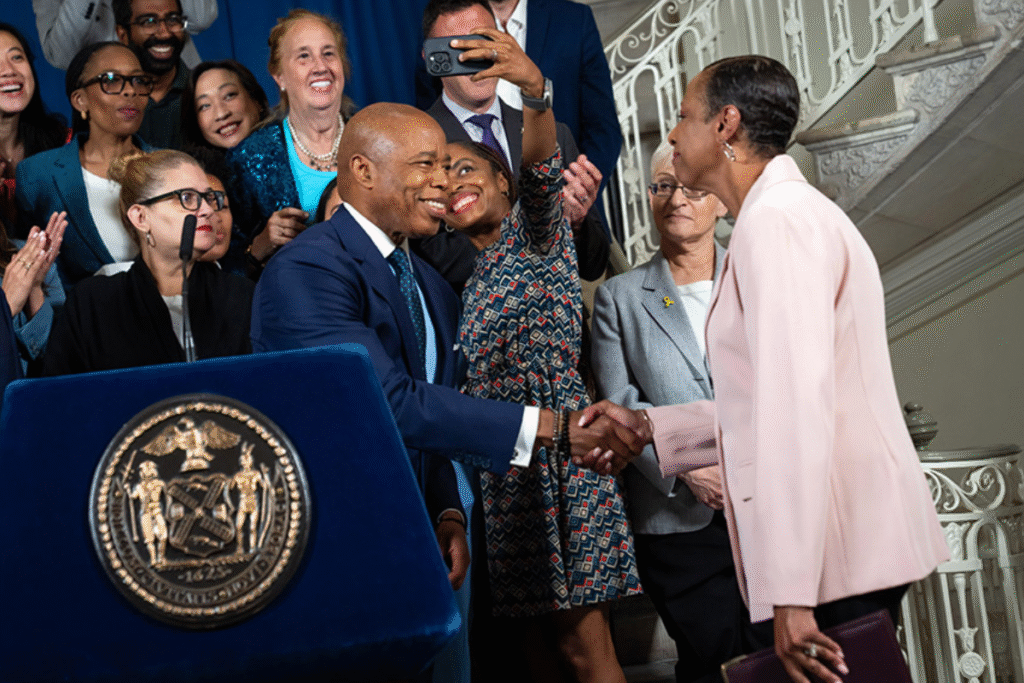
Mayor Eric Adams, joined by City Council Speaker Adrienne Adams and Council Finance Chair Justin Brannan, on Friday announced the adoption of New York City’s Fiscal Year 2026 budget. A record-setting $115.9 billion plan aimed at creating a safer, more affordable, and more equitable city.
Hailed as the “Best Budget Ever,” the FY 2026 Adopted Budget features sweeping investments in public safety, affordable housing, education, immigrant services, and early childhood care, all while maintaining strong fiscal discipline. For the first time in city history, the budget eliminates personal income tax for more than 582,000 low-income New Yorkers — a move expected to return $63 million to working families.
“This budget meets the moment for our city,” said Mayor Eric Adams. “We’ve crafted a responsible, on-time, and balanced budget that puts people first — making critical investments in public safety, education, and affordability without raising taxes or cutting services.”
A Historic Tax Relief for Working Families
For the first time in the city’s history, the budget abolishes New York City personal income tax for eligible low-income filers through Mayor Adams’ “Axe the Tax” initiative. This policy will return $63 million to more than 582,000 low-income residents and their dependents living at or below 150 percent of the federal poverty level, easing the financial burden on working-class families and improving affordability.
Investing in Public Safety and Community Well-Being
Public safety remains a cornerstone of the budget, with investments aimed at expanding the NYPD workforce to reach 35,000 uniformed officers by fall 2026. The budget supports programs to reduce gun violence, improve transit safety, expand youth engagement through initiatives like “Saturday Night Lights,” and increase mental health support through additional clinicians.
Significant funding is allocated for immigrant legal services, including $41.9 million for free legal assistance and $12.5 million for pro-bono attorneys representing unaccompanied minors facing deportation. The budget also enhances the capacity of district attorneys’ offices to combat gang, youth, and domestic violence, while boosting forensic capabilities.
Enhancing Quality of Life and Infrastructure

The FY 2026 budget bolsters the city’s parks and recreation departments by funding 170 additional enforcement and maintenance staff to keep public spaces safe and clean. It establishes the Division of Sustainable Delivery to regulate commercial e-bikes, addressing growing concerns about delivery safety and congestion.
Continuing the “Trash Revolution,” the budget provides $5 million to support Business Improvement Districts in securing rat-resistant sanitation bins. Additionally, $5 million funds the 988 crisis intervention and suicide prevention lifeline, expanding mental health crisis resources.
Expanding Affordable Housing and Early Childhood Education
Mayor Adams’ administration has set ambitious housing goals, including a $24.7 billion investment in affordable housing through the city’s 10-Year Capital Plan. The new budget supports childcare initiatives, with $229 million allocated for childcare vouchers and a $10 million pilot program for infant and toddler care.
Food security programs receive a $15 million boost to support over 700 food pantries citywide. Support for minority- and women-owned businesses is strengthened through a $2 million fund aimed at addressing high insurance costs.
Commitment to Education and Youth Development
The budget launches “After School for All,” a $755 million initiative providing universal after-school programming to K-8 students citywide, expected to serve 184,000 children by 2027. Education funding is stabilized with $128 million to ensure schools do not lose funding despite enrollment fluctuations, while investments continue in special education pre-K, class size reduction, and early literacy programs.
Higher education and adult learning are supported through $7.8 million for the CUNY Reconnect program, helping adults complete degrees and improve career prospects.
Transformative Capital Projects and Environmental Resilience
The administration continues to invest in transformative projects including the Brooklyn Marine Terminal redevelopment, Willets Point housing and commercial developments, and Atlantic Avenue community improvements. New funding supports environmental impact studies for the Financial District and Seaport Climate Resiliency Project and public-private partnerships to revitalize Manhattan’s 14th Street.
Strong Fiscal Management Amid Economic Challenges
The budget maintains record-high reserves totaling $8.5 billion, including $2 billion in the Rainy-Day Fund, to safeguard against economic uncertainties such as federal funding cuts and global trade tensions. The city achieved nearly $1 billion in savings without cutting services or raising taxes, demonstrating prudent fiscal stewardship.
Tax revenues are projected to grow by $617 million compared to previous estimates, driven by a robust economy, though the administration remains cautious about future revenue trends.
Mayor Adams summarized, “This budget is a testament to our commitment to a safer, more affordable, and thriving New York City for all residents. By investing smartly in public safety, education, housing, and legal support, we’re ensuring our city remains the best place to live, work, and raise a family.”
City Council Speaker Adrienne Adams added, “The Council is proud to have worked tirelessly with the Mayor to deliver a budget that responds to the needs of every New Yorker—from expanded childcare and library services to programs supporting mental health and public safety. Together, we are building a stronger and more equitable city.”